Cracking the code: Neurodivergence and creative AI
May 13, 2026 - 2 min read
Unlocking the Second Life of EV Batteries: A Path to a Resilient Energy Grid
(This article was generated with AI and it’s based on a AI-generated transcription of a real talk on stage. While we strive for accuracy, we encourage readers to verify important information.)
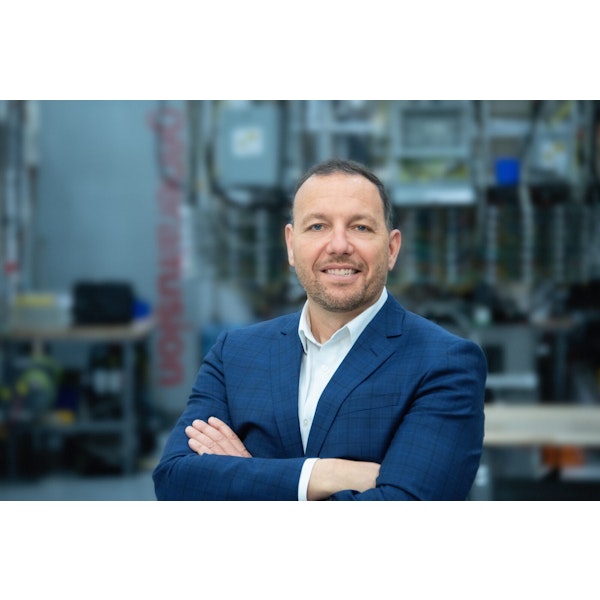
Edward Chiang, CEO and co-founder of Moment Energy, outlined the company’s dual mission: preventing electric vehicle (EV) batteries from landfills and enhancing the energy grid. Based in Greater Vancouver, Moment Energy repurposes retired EV batteries for stationary storage, extending their useful life by 10 to 20 years before final recycling.
Mr. Chiang clarified Moment Energy’s role as upstream of traditional recycling. He noted that despite significant investment, battery recycling often isn’t profitable, with costly shipping of “black mass” to China. Repurposing, conversely, involves testing and reassembling battery modules, treating them as “Lego blocks” for a productive second life.
Moment Energy’s systems are deployed in diverse settings, including Vancouver International Airport, hospitals, and manufacturing facilities, supporting North American domestic production. Journalist Vince Beiser highlighted the inherent efficiency of reusing items, which is more energy-efficient and cost-effective than extensive recycling, drawing a parallel to reusable milk bottles.
Mr. Chiang observed a growing cultural shift in North America towards repurposing, driven by sustainability and national security. Reliance on China for 90% of global battery production has spurred efforts to onshore manufacturing. North America’s competitive edge lies in technological innovation for cost-effective, high-quality production, rather than cheap labor.
Mr. Beiser questioned the industry’s growth, noting its small size and past failures of recycling companies due to insufficient feedstock. Mr. Chiang confirmed many battery recycling ventures became unprofitable, with shipping costs often negating potential gains. He mentioned Moment Energy’s $26 million grant from the US Department of Energy for a Texas gigafactory.
Repurposing offers significantly higher profit margins, selling at $200-$1000 per kilowatt-hour, making shipping costs manageable. Moment Energy aims for at least 30% margins. Mr. Chiang projected a substantial influx of end-of-life batteries, estimating 950 gigawatt-hours (12 million EVs) in the next two years, far exceeding current processing capabilities.
Addressing competition, Mr. Chiang welcomed more repurposing companies, recognizing the immense scale of the challenge. He emphasized Moment Energy’s distinct focus on safety, a priority for its largest investor, Amazon. This commitment led to Moment Energy achieving the world’s only full UL certification for second-life batteries by June 2025.
This UL certification enables Moment Energy to safely integrate batteries into the grid and deploy them in various built environments, such as commercial towers and EV charging stations. Mr. Chiang explained how these batteries can support AI data centers by charging during off-peak hours and discharging during peak demand, stabilizing the grid and preventing increased energy costs for communities.